After the successful adoption of ITRS in Garda Trentino and its wider recognition as the official Regional Trail Rating System in the whole Trentino region in Italy we are proud to share that ITRS has been adopted at the national level in Finland: the first time the International Trail Rating System has been built into a whole country’s official trail infrastructure.
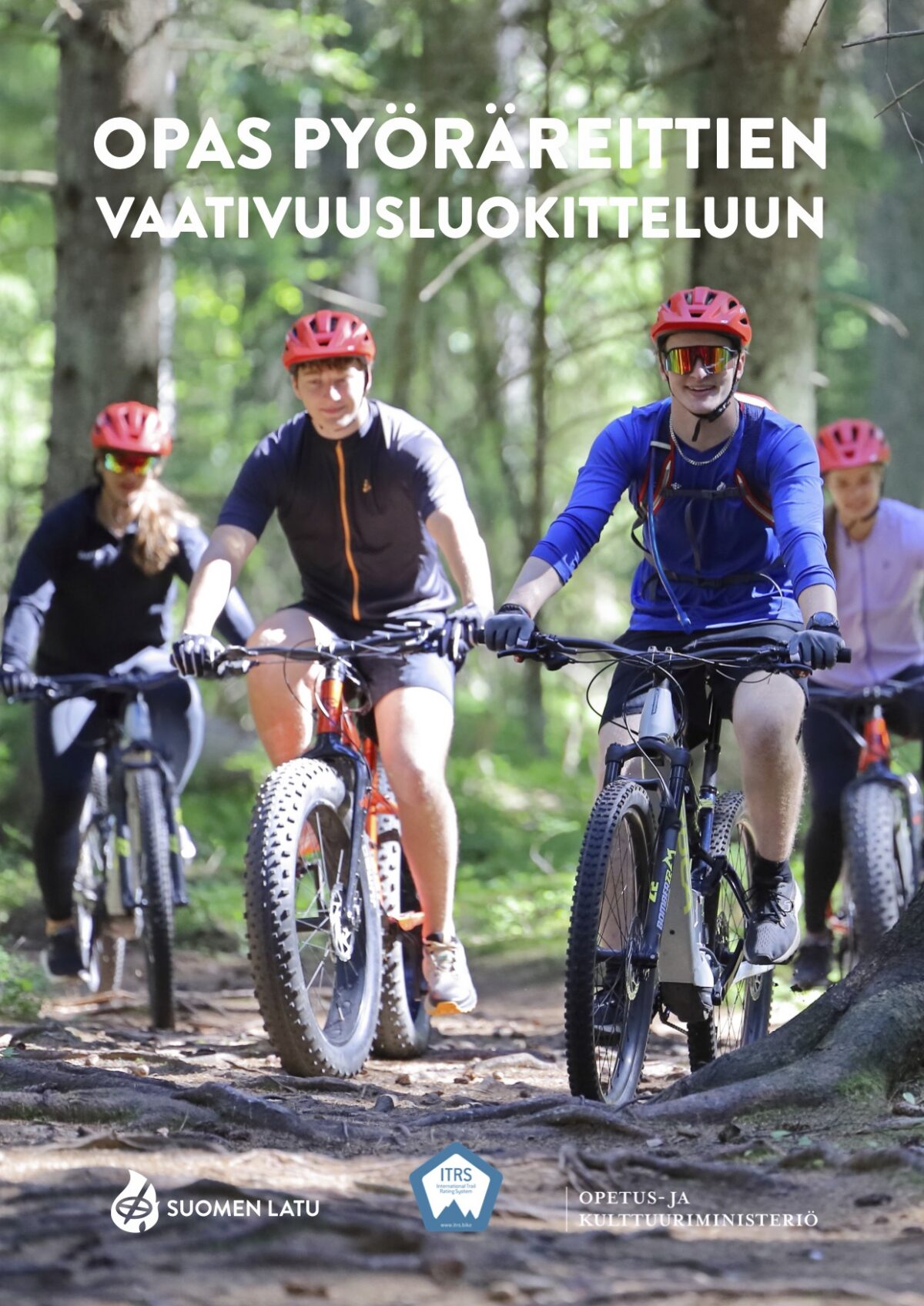
The adoption is the result of a mountain biking project led by Suomen Latu, Finland’s largest outdoor organisation, together with the Uusimaa recreation-area association (Uudenmaan virkistysalueyhdistys) and funded by the Finnish Ministry of Education and Culture. As part of the project, the full ITRS framework was translated into Finnish, and a national Finnish-language classification guide was published.
What makes this more than a translation exercise is where the classification lives. ITRS ratings are now entered into Lipas, Finland’s national sports- and recreation-facility database, and will appear on Luontoon.fi, the outdoor-services site maintained by Metsähallitus, Finland’s state land-management agency. In other words, ITRS isn’t sitting in a brochure but it’s becoming part of the data layer that riders, planners, and land managers already use.
For Suomen Latu, the appeal is practical. The guide works above all as a tool for trail maintainers, says project lead Topi Kiljunen (an ITRS Certified Trail Rater), and helps make mountain biking both more accessible and safer at all skill levels. A shared, national classification gives trail builders and maintainers one consistent language for describing what a route actually demands which in turn helps newcomers choose trails that match their ability and ride on clearly marked, more approachable routes.
That philosophy is core to how ITRS is designed. As Kiljunen describes it, the system is built first and foremost as a communication tool: it doesn’t recommend or restrict, but helps the rider decide for themselves whether a route suits their skills and readiness. ITRS evaluates trails across four dimensions: technical difficulty, endurance, exposure, and widerness and works at both the level of a single trail segment and a whole route.
Finland’s adoption is a meaningful proof point for ITRS as an international standard. It shows that the framework can move beyond individual trail networks and operate at the scale of a national system: translated, localised, embedded in public data infrastructure, and backed by a major outdoor organisation and a government ministry. It also validates the model of working through a trusted national partner rather than imposing a standard from outside — Suomen Latu owns the rollout, the Finnish localisation, and the relationship with riders and land managers on the ground.
We’re proud to see ITRS put to work in Finland, and grateful to the team at Suomen Latu for the care they’ve taken in bringing it into the Finnish outdoors. It’s exactly the kind of partnership ITRS was built to enable and, we hope, the first of many at this scale.
Find out more on Suomen Latu’s website (in Finnish):
Suomen Latu julkaissut maastopyöräilyn vaativuusluokitteluopaan – ePressi